() -- Hong Kong is under growing pressure to loosen its rules so that more Chinese companies can shift their listings to the city from the US, part of the fallout of rising distrust between Beijing and Washington, according to people familiar with the matter.
In recent discussions, companies exploring Hong Kong listings pushed back against altering their corporate structures to meet the city’s limits on dual-class shares, said the people, asking not to be identified as the discussions are private. The Securities and Futures Commission, however, has so far held firm on sticking to the rules, the people said.
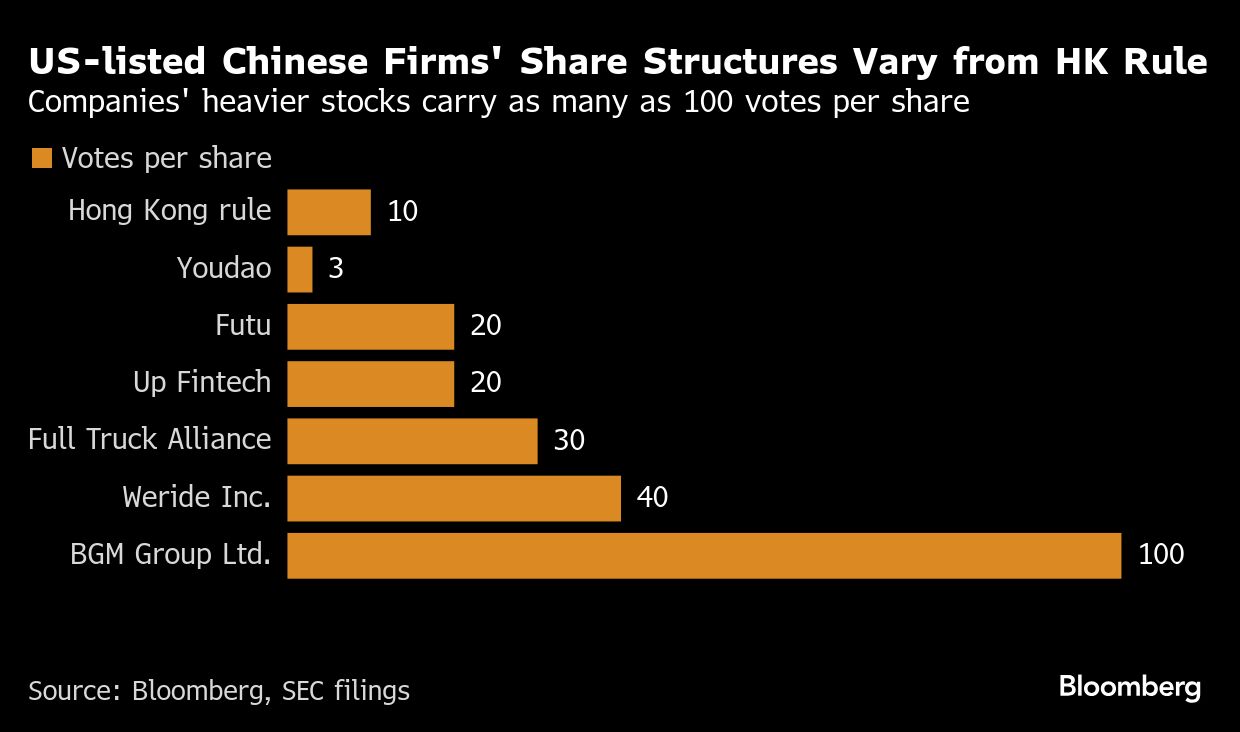
Dual-class structures involve shares with different voting powers and Hong Kong has set a limit of 10 votes per share for companies valued at HK$10 billion ($1.3 billion) or more. Also taking into account other protective measures for investors, 22 of the 27 Chinese companies listed in the US with market capitalizations above $1 billion have voting structures that don’t comply with the rules, according to calculations.
Listing in Hong Kong regained urgency after US President Donald Trump slapped massive global tariffs in April and raised the threat of more Chinese delistings. Some $1.1 trillion in Chinese shares are at risk of being pulled from New York in an extreme scenario, if mistrust intensifies between Washington and Beijing. Hong Kong’s exchange has emerged as the natural winner and in recent years saw firms such as Tencent Music and Bilibili Inc. adding dual-primary listings in the city alongside New York.
The SFC welcomes “high quality companies to list” and “is working with HKEX to facilitate companies wishing to make Hong Kong the preferred listing destination taking into account their actual circumstances and practical needs,” a spokesperson for the regulator said in a statement.
Trump and Xi on Thursday agreed to further trade talks during a one-and-a-half hour conversation .
The dual class issue is being discussed at the highest level of Hong Kong’s government as well as the Chinese Liaison Office, with both expressing the intention to help speed up the process, the people said. The issue is seen as transcending pure financial matters, with policymakers keen on ensuring the listings of major Chinese companies aren’t used as bargaining chips, the people said.
“The Government will seize the opportunity presented by the return of China Concept Stocks, and is committed to making Hong Kong their primary listing destination,” a spokesman for the Financial Services and the Treasury Bureau said.
The SFC and Hong Kong exchange are looking at enhancements of the listing regime, including reviewing requirements for primary, secondary and dual primary listings, which will be announced with a market consultation once ready, the spokesman said.
The Chinese Liaison Office didn’t immediately respond to written requests seeking a comment.
Dual class shares have long been controversial in Hong Kong. The city only started accepting dual-class shares in 2018 after losing the $25 billion Alibaba Group Holding Ltd. IPO to New York. It now accepts such companies with at least HK$10 billion market capitalization, and limits the voting proportion to a maximum of 1:10. The super voting shares then lose their privilege, or so-called “sun-set,” when the holder dies, leaves the company or the shares change hands.
Many of the New York-listed firms have weighted shares that surpass Hong Kong rules. Futu Holdings Ltd. have shares with 20 votes, while Full Truck Alliance Co. 30 votes and Weride Inc. 40 votes and BGM Group Ltd. 100 votes.
Read More:| Why US-Listed Chinese Stocks Face Expulsion Threat: QuickTake |
| Hong Kong Opens Door for Stocks U.S. Wants to Expel: China Today |
| Bessent Says Everything Is on Negotiating Table With Tariffs |
| Ex-Goldman Banker Leads China’s Push to Revive Hong Kong Finance |
Regulators are grappling with how to be fair to all issuers, the people said. Investor protection is the top priority when considering listing applications and founders with heavier votes should be able to steer their companies toward complying with Hong Kong rules as earlier firms did, the people said.
When Hong Kong first introduced the weighted voting rights regime in 2018, it was mainly to attract businesses and profits. Some market practitioners argue the current geopolitical tension is a material enough a change to justify a holistic review of the regime.
The SFC and Chinese firms have explored potential workarounds, including the possibility of granting interim waivers that would let companies list with their existing share structures—provided they commit to a future time-line for compliance, some of the people said. However, no agreement has been reached, and the talks remain at an early stage, the people added.
Only companies listed before the new rule came in place in 2018 are allowed to keep their original structure when getting a secondary listing in Hong Kong. The deadline was to deter Chinese companies from listing on a foreign exchange and then seeking a secondary listing in Hong Kong to avoid primary listing requirements from the city, HKEX said in 2018.
A spokesperson for the Hong Kong exchange said it’s committed to “supporting the listing of high-quality companies” and welcome “all firms that meet our requirements.”
(Adds detail on call between Trump and Xi in sixth paragraph)
Most Read from
- Next Stop: Rancho Cucamonga!
- ICE Moves to DNA-Test Families Targeted for Deportation with New Contract
- Where Public Transit Systems Are Bouncing Back Around the World
- US Housing Agency Vulnerable to Fraud After DOGE Cuts, Documents Warn
- Trump Said He Fired the National Portrait Gallery Director. She’s Still There.
©2025 L.P.
Comments
Post a Comment