The journey of mobility startup CaPow didn’t start with an army intelligence unit or a tech garage, as do many Israeli ventures. Rather, it has its beginnings in a university lab in Beersheba in southern Israel.
For over a decade, Mor Peretz, a professor of electronics at Ben-Gurion University of the Negev, and two of his PhD students, toyed with the idea of building wireless charging technology that can power autonomous robots while they are on the move.
“I am not the typecast of a professor — not only in appearance, but also in the domain, which is very experimental and applied in nature,” Peretz told The Times of Israel, wearing a simple T-shirt typical of his down-to-earth persona. “Most of my career was conducted in very tight interaction with the industry.”
Academia would not have been the natural path for 45-year-old Peretz, who is the father of two boys, but an accident during his military service left him permanently disabled without the use of one of his legs. A lengthy rehabilitation process prompted his family to encourage him to enroll at the Sami Shamoon College of Engineering in Beersheba.
Peretz was accepted into an accelerated electrical and electronics engineering program, which he was able to pursue as the college crafted a flexible curriculum to balance his studies with frequent physical and hydrotherapy treatments.
His ambition and academic performance propelled him to become the first graduate of the college to transition to a master’s degree at Ben-Gurion University and the first in his family to attain a university degree. He ultimately earned a doctorate and became a tenured professor by the age of 40.
As the conception of robots that can compete with humans in performing automated tasks gains traction — whether in large logistics warehouses and factories or doing general-purpose chores — the main challenge is a continuous energy supply without interruptions or downtime, said Peretz.
Based on his applied research in energy delivery, Peretz, together with PhD graduates Alon Cervera and Eli Abramov, set out to develop the “secret sauce” for eliminating traditional energy bottlenecks.
“From grocery stores that run automated deliveries to large fulfillment, logistics, and manufacturing centers, they all share a common pain — which is the significant downtime that is associated with charging robots, as they are not working during that time,” Peretz said. “What we are after is taking the energy issue out of the equation by finding the best way to have robotic fleets work 100% of the time without compromise.”
Although technology solutions in recent years have helped cut charging time, they are still not fit to support a future of fully autonomous robotic systems, Peretz said, mainly because they still require robots to stop and reroute to charge. Every minute a robot parks to charge is another minute of workforce and revenue loss.

“Today’s work-to-charge ratio is about three to one, meaning three hours of work, one hour charging time,” said Peretz. “This implies that if you have 100 robots, you need at least 130 robots just to compensate for that downtime.”
On a mission to solve the energy challenge, the scientists led by Peretz harnessed electric rather than magnetic fields to build a wireless energy system to seamlessly and continuously charge moving robots using the radio frequency wave technique. The wireless solution aims to eliminate the need for charging docking stations that take up extra space, as well as downtime, battery changes, and workflow detours.
After running simulations in the university lab, Peretz and research scientists Cervera and Abramov in 2018 co-founded CaPow, a comicbook-sounding play on the words capacitive power. The team seeks to power robots as they operate in large warehouses and logistics centers such as those belonging to Amazon, and manufacturing facilities such as those in the automotive industry.
In March, CaPow raised $15 million in fresh funds led by Toyota Ventures, the investment arm of the automaker giant.
“In a very similar way that a radio searches for a station and stays tuned even though you drive around or are in different weather conditions like rain or clouds, the idea of CaPow is to stay tuned,” said Peretz. “Our model searches for the best energy station or energy channel that is available, and the system adjusts its characteristics to the optimum power transfer.”
Roots in the Negev
Ben-Gurion University alumnus Peretz said the startup was deliberately based in Beersheba, tied to a vision of building tech excellence beyond Israel’s center.
“We are very strong believers in the Negev,” said Peretz. “We grew up here and we would like to keep the roots here.”
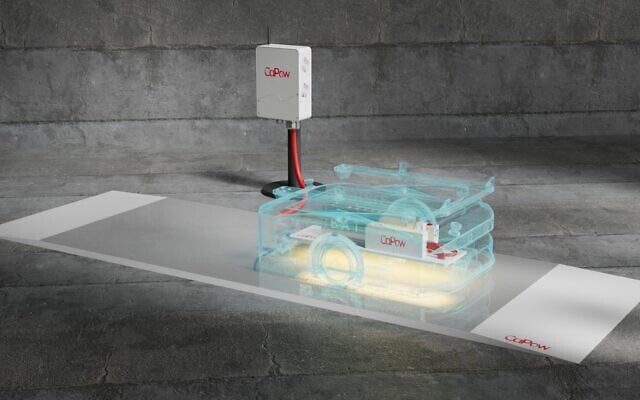
CaPow’s flagship system is built on a capacitive wireless energy transfer model that places thin charging pad “stickers,” or modular floor transmitting antennas, along key high-traffic or strategic areas within a warehouse, and an internal power receiver installed in the robot. As the robot rolls over the sticker for a “sip of energy,” an onboard receiver converts energy from the ground pad into power until it reaches the next sticker.
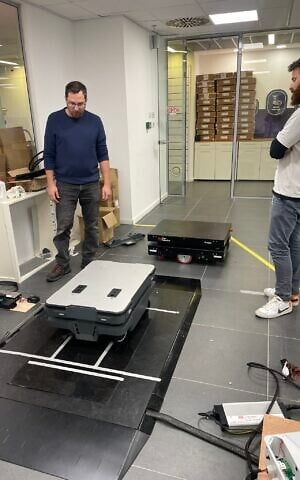
“While the robots are conducting their tasks, they are getting energized, whether along a designated aisle that they pass through, or in the queue waiting to be loaded up or unloaded,” said Peretz. “Instead of depleting the battery altogether and then charging it full, we can trickle charge it, and this extends the lifetime of the solution.”
“The deployment is agnostic to the type of surface and can be installed on concrete, metal, wood, or shelves, and has already been demonstrated on more than 20 types of robotic families,” he added.
The system enables operators of mobile robots in warehouses, factories, and logistics centers to eliminate charging downtime, reduce robotic fleet sizes by up to 20%, and reclaim floor space that is otherwise lost to charging zones, according to the Israeli startup. Peretz said customers have reported a reduction of up to 32% in the total costs of automation systems.
“We worked very hard to develop a headache-free, plug-and-play energy solution that is seamless from an integration and deployment perspective,” said Peretz. “What sets the system apart is that it provides energy in motion, is super easy to deploy, and maximizes productivity.”
Peretz noted that CaPow’s technology also mitigates the risks associated with traditional battery charging, such as overheating and exposure to electrical conductors, which in turn makes it a safer choice for industrial settings.
“Our solution also helps reduce dependency on lithium-ion batteries that power nearly every modern device, from smartphones to electric bikes, which are not only costly but can ignite dangerously,” said Peretz.
Israeli startup CaPow is the developer of an energy system that provides robots with a non-stop power supply while in motion. (Courtesy CaPow)CaPow has a partnership with Hyundai Glovis, the logistics division of Hyundai Motor Group, which said last week that it completed a trial of its power-in-motion energy platform at its facility in South Korea. The trial demonstrated a 15% increase in operational efficiency by eliminating charging downtime versus traditional charging methods. Hyundai Glovis operates fleets of automated guided vehicles, including forklifts and other transporting pallets, across logistics warehouses and advanced manufacturing facilities.
Aside from Toyota, other investors included IL Ventures, Payton Planar Magnetics LTD., Mobilion, and Doral Energy-Tech. Peretz said the funding will be used to expand the startup’s footprint first in the US and then in the European market, grow international operations, scale R&D, and ramp up production.
“We aim to produce several hundred units or even 1,000 units a month in about two years, from the current average of about 100 a month,” said Peretz. “Our longer-term vision is to power larger vehicles in the automation world, including forklifts and tugger fleets, as well as enable humanoids to operate 24/7 without energy bottlenecks.”
Times of Israel staff contributed to this report.
The post How an injured IDF veteran-turned professor is creating perpetual power for robots appeared first on The Times of Israel .
Never miss important Israel stories - get the free Times of Israel Daily Edition
Comments
Post a Comment